SATYAGRAHA : THE REALITY OF GUJARAT TODAY
- Fr. Cedric Prakash sj*
- Fr. Cedric Prakash sj*
INTRODUCTION
Friends,
I feel greatly honoured and privileged to be a part of this great Conference on “Satyagraha – a ProPeace Agenda” which has been organized by Ms. Ela Gandhi and the Gandhi Development Trust. I feel very happy, at this moment, to be able to share with you my thoughts on the theme of this Conference with a perspective from Gujarat, the Land which gave birth to Mahatma Gandhi and in which he spent so many years of his life in the Satyagraha Ashram from where he ultimately launched the ‘Quit India Movement’ against the British.
A few weeks ago, on Sunday, 20th August, I visited the Gandhi Ashram briefly, just to see the turbulent waters of the river Sabarmati which had destroyed hundreds and thousands of homes of poor slum dwellers who lived on its banks. As I entered the Ashram, the huge board caught my attention and in that, was very boldly written that those who lived in the Ashram had to make “a constant search for truth”. It was here that Gandhi began his historic foot-march, recalling Buddha’s renunciation of old, with a vow not to return to this place, till he achieved freedom for India.
At that moment, I tried to wonder what freedom meant for me and for perhaps the hundreds and thousands of poor slum dwellers who had lost all their meager possessions because of sheer callousness of the Government who released thousands of cusecs of water into a bed of sand which had all along its banks, huge buildings and other monstrosities made of mortar, brick and stone; I wondered what freedom meant to me, because on that day, the Catholic Church throughout India was observing Justice Sunday, with a pledge to fight against corruption that has become so much part of an Indian way of life; I wondered what freedom meant to me when I know that since 2002, hundreds and thousands of Muslims in the State of Gujarat have not been able to go back to a place which they once called their homes, apart from the fact that there are many grieving the loss of a loved one or of their material possessions or the fact that they are second-class citizens in a State which for years sang that song which Mahatma Gandhi popularized in this Ashram “Ishwar Allah tera naam, sabko sanmati de Bhagwan” (whether we call you Ishwar or Allah, we ask You to treat us as one).
Yes, on that day, in Gandhi’s Satyagraha Ashram, I wondered what freedom was for me and for thousands of my brothers and sisters who are subject to all kinds of hardships and sufferings and as I make this presentation to you, I am still wondering what this freedom means in the context of the Gujarat I live in today…..
The Upanishads is one of the most sacred scriptures of the Hindus. There is a very challenging dimension which is highlighted, in which the devotee says this prayer to God…
Lead me O Lord
from darkness to light,
Lead me O Lord
from untruth to truth,
Lead me O Lord
from death to immortality.
That constant urge and search for truth became the cornerstone of Mahatma Gandhi’s campaign to provide for India, freedom from colonial rule. He called it “Satyagraha” (meaning force of truth), and he based it on the doctrine of “Ahimsa” (non-violence). These two principles, namely “Satyagraha” and “Ahmisa” which in latter years, epitomized Gandhi , was the ultimate weapon in pursuit of freedom. That India achieved this goal, by using these weapons, is as clear as daylight. That India in almost sixty years of independence has not succeeded in mainstreaming these values, can be seen in the brutal and fragmented world that so many Indians live in today.
Mahatma Gandhi also held in very high esteem, John Henry Cardinal Newman, who some years earlier, in his search for truth, wrote that immortal poem “Lead kindly light amidst the encircling gloom”. Gandhi had this poem translated into Gujarati and it became one of the favourite hymns of his Ashram too. A man committed to peace, but realizing fully, “peace” is always in the context of “truth”.
Today, the very Gujarat that became the launching pad for Gandhi’s assault for freedom, has now become a new battleground, as politicians manipulate people in the name of religion. Truth and non violence, harmony and peace have been sacrificed at the altar of violence and religious fanaticism.
However, there have been positive responses not to allow the torches of “truth” and “peace” to be totally extinguished. During this presentation, I hope to look at some dimensions of our reality in Gujarat by providing you some insights into what has been happening and also to look at the ways we are responding to a society which has been divided in the name of religion.
SITUATING INDIA
India is regarded as the cradle of great civilizations; the Indus Valley Civilization is comparable to the civilizations of the Greek and the Romans. The artifacts and seals found in its ruins indicate a highly sophisticated way of living which can rival even some of the current civilizations of the world. Besides, for centuries, India has been a pot-pourri of cultures, and has embraced diverse faiths and traditions, from the world over. This is partly due to “foreign” domination - the Aryans (who came from the plains of Central Asia more than 3000 years ago), the Mughals, the Dutch, the French and finally the British - which ruled India for several centuries; but it was also because the very nature of Indian society was to assimilate and be assimilated, into the wealth of diversity which came along. This steady influx has made India the rich civilizational palimpsest that it is.
All through, religion has played a significant role in determining the cultural and moral ethos of the country. "Religiosity" seems to have gripped the country from the Indus Civilization; the Vedic age (which is traditionally regarded as the start of the Hindu Era of the country;) contributed to the fact that the vast majority of India's population are adherents of the Hindu faith (with all its diversity). However, there are sizeable sections of the population who follow Islam, Christianity, Sikhism, Jainism and Buddhism….There are also small percentages of followers of Judaism, Zoroastrianism and other faiths. A good section of the tribal population of India are fundamentally Animists and the sizeable Dalit population of the country would categorically state that they do not belong to the mainstream Hindu faith.
Over the years, within India too, there has been a long history of migration, displacement and even relocation. In most parts of India, you can find people belonging to different cultural, ethnic and religious groups. Indians also have a long tradition of “settling abroad”. That is why you have Indians today in every corner of the globe from and from Chicago to Canberra. It surely speaks strongly that India not desired to embrace all but also tangibly wished to be embraced in return.
Into this melting pot, the ascent of globalization has brought newer needs and a different value system, very specially in urban India. Celebrating Valentine’s Day or listening to rock music ; eating at a McDonalds or hooked onto cyberspace, has jettisoned a fairly large section of India into a virtual global village. On the other side, there is a rise in orthodoxy, with more emphasis given to ritual practices, and even into questionable acts of superstition and obscurantism. There is a proliferation of "places of worship" and one can easily see the mushrooming of temples in India by the side of modern high rise buildings.
India is truly at the crossroads ! There is a raging debate between the Nehruvian model of "temples of modern India" (namely dams and the whole baggage of industrialization) and the proponents of the Babri Masjid - Ram Mandir agenda which has literally taken the country a few centuries back. On the one hand, India seems to be poised to take its place among "the super powers" of the twenty-first century, (there has been a raging debate recently both in India and abroad of India joining the Nuclear club) yet, on the other hand, there are forces which seem to be determined to take the country back to parallels of the dark obscurantist ages of Europe.
India's pluralistic traditions is today challenged from all quarters and there is no other place in which this is so overwhelmingly manifested than in Gandhi’s Gujarat (a State in North-west India). Since 1990, one sees here, not merely the emergence of fundamentalist forces but also a “nouveau culture” which seems to be what the middle class is all hooked upon.; a concept of one nation, one language, one culture, one belief……yet, with all the blessings that the trappings of modern civilization can bring. This culture finds expression in intolerant and violent behavioral patterns…..far away from the traditions and heritage of India’s glorious past, so vividly epitomized by Ashoka and Akbar, great rulers of bygone years.
THE GUJARAT CARNAGE
In the very heart of the city of Ahmedabad, which is the commercial capital of Gujarat, in North-west India, stands the Sidi Saiyed Mosque named after its builder. The most exquisite craftsmanship in stone carving can be seen in this Mosque which was built in 1572. The distinguishing features of this mosque are the ten intricately carved stone windows. One of the windows depicts the “tree of life” with delicate intertwining of the branches of a tree. For years, this motif was the symbol of Ahmedabad and in fact, of Gujarat. In a way, it symbolized all that India meant and stood for : diverse cultures, faiths, languages, traditions, peoples….yes, everything which indeed made up a great civilization. Very different but very united. A unity in diversity. A unique tapestry, inter-woven with multi-colour hues as the light of the sun and the moon pierces the gaps of the window. It is magnificent !
Yet on the other hand, a few years ago, when the Hindu right-wing Government took controls of the reigns of power in the State of Gujarat, one of their first decisions was to ensure that this replica of the stone trellis was no longer used as a symbol of Gujarat and of Ahmedabad. They quickly replaced it with the replica of a temple. The move was significant because in one stroke it demonstrated all what India is about today : a country with a great and rich past but with a very tenuous future. The diversity that characterized this civilization has now become the source of bitter division, hatred and violence; religion is used as a tool to manipulate people for petty political gains…..The intricacy and the beauty of the “tree of life” literally stands to be poisoned at its very roots.
One needs to situate this article in the “tree of life” of Ahmedabad city because in February/March, 2002, the “tree of life” of Ahmedabad city which was intrinsic to Gujarati society was shattered beyond recognition.
When I refer to the “tree of life” I also mean to communicate the fact that so much of India has also not been able to sustain the wealth of our diversity. This is totally true of Gujarat where over the years, the beautiful and interwoven tapestry has just been destroyed to shreds. In Gujarat, it was not just “a once and for all”. It has emerged over a period of time in subtle, covert and insidious ways.
On November 21st 2002, the Concerned Citizens’ Tribunal consisting of several eminent citizens and headed by Justice V. Krishna Iyer, a former Judge of the Supreme Court of India, made public a report entitled “ CRIME AGAINST HUMANITY ”, on the Gujarat Carnage which began on 27th / 28th February 2002. This report was on the basis of more than 2000 oral and written testimonies both individual and collective from victim-survivors and also independent Human Rights Groups, Women’s Groups, NGOs, academics and others. The Tribunal, in its findings and recommendations clearly indicts the Government of Gujarat and holds them responsible for the unfettered violence, murder, arson and loot that took place in Gujarat last year. This violence, (though not an “action-reaction” syndrome) followed the burning of the S-6 compartment of the Sabarmati Express Train in Godhra (in Eastern Gujarat) and the death of fifty-nine people.
What took place in Gujarat has already been well-documented in studies, analyses, reports by fact-finding teams, human rights groups, statutory bodies like the National Human Rights Commission and the media, besides others (both in India and abroad). I don’t think it is necessary to get into the nitty-gritty of the events. The details of the carnage are gory and horrendous : almost 2000 Muslims were killed, many more were injured or brutalized, several hundreds of women were raped and the extent of damage to homes and establishments can hardly be quantified. Gujarat has not yet recovered from the massive losses incurred by every strata of society during that period.
The major trends which emerged from each of these reports (including the Human Rights Watch Report of 2003) and which corroborate the findings of the Citizens’ Tribunal are :
- what took place in Gujarat was not merely communal violence or riots; it was a genocide, a carnage, an ethnic cleansing, designed to wipe out or to ostracize a whole community.
- the carnage was well-planned and well-executed. It was not a “spontaneous” reaction as it was made out to be. The preparations must have taken several months. Already a year earlier, a widely circulated Gujarati daily listed several hotels run by the Chilya community which had non-Islamic names. Most of them were, during the carnage, razed to the ground. A meticulous census was conducted on the Muslims and Christians of Gujarat in 1999. The data was sufficient to help rampaging mobs to know exactly whom to attack and where.
- the carnage was meant to break the backbone of the Muslim economy. It has succeeded to a great extent.
- the middle-class( including several well-to-do and educated women ) were blatantly involved in the violence; there were very few who were willing to come out and take a stand to prevent what was
happening.
happening.
- in some areas, tribals and dalits were very effectively used in the arson and looting of Muslim homes and establishments.
- it was a State-sponsored genocide. The Citizens’ Tribunal has clearly indicted, besides the Chief Minister and politicians, several high-ranking bureaucrats and police-officials. The Sangh Parivar was given a free hand to do what they wanted. The police were apparently given clear instructions not to take any action. There is also evidence to show that some were encouraged to join in the violence which they did, with ruthless finesse. State Ministers and leaders of ‘the Parivar’ (like the mafioso) were seen leading the mobs.
Today, more than four years later, the ground situation in Gujarat has in fact, only worsened. Even as I write this (inspite of the recent floods which devastated life and property all over Gujarat and the fact that several parts of the State are still gripped with pandemics) the Government of Gujarat still intends to organize night nights of festival during the traditional Navratrai period at the end of this month on the banks of the river Sabarmati. This colossal waste of public money is ironic because what is intend to be portrayed is anything but the reality of Gujarat.
Let’s briefly look at the reality in Gujarat today :
Ø if one is a Muslim today in Ahmedabad, one cannot buy a house or own a shop in the western up-market part of the city. Muslims are normally confined to ghettoes in the eastern part of the city or in some rare pockets in the western part.
Ø most Muslims in Gujarat continue to live in fear and insecurity.
Ø an insignificant incident can spark off a major riot.
Ø State-sponsored terrorism continues with frightening regularity. In the past couple of years, several Muslim youth have been killed in “police encounters”
Ø in Baroda sometime ago, several young Muslims were detained under PASA and a respected Muslim cleric was also arrested for allegedly being one of the master-minds of the Godhra train burning. In the Central Jail in Ahmedabad, there are 200 detainees under the Prevention of Terrorism Act (POTA). All of them happen to be Muslims.
Ø some of those who are accused of the violence against the Muslims have been elected as MLAs and some have even become Ministers.
Ø the Sangh Parivar continues its vicious campaign against the Muslims, Christians and other vulnerable groups with impunity. Recently, new anti-Christian leaflets were distributed across the State.
Ø even the judiciary has been tampered with; there are public prosecutors appointed by the Government who have primary membership in the RSS / VHP. (It is therefore not without reason that the Supreme Court of India has said that it has very little faith in the Gujarat judiciary.)
Ø the Textbooks brought out by the Gujarat State Textbook Board, are replete with untruths, inaccuracies and with prejudicial statements against the Muslims and Christians
Ø on August 6th this year, at an examination of the Gujarat Public Service Commission for Medical Officers, almost fifteen of the hundred questions asked were communally sensitive and directed against Muslims and Christians.
One needs to go back to March 1998 when the Hindu nationalist BJP (Bharatiya Janta Party) won a two-third majority in Gujarat. It was the very first State in the country which gave them such a massive mandate with unqualified support. The build up to this victory was gradual but efficiently planned ; that Gujarat was bound to become the laboratory for the Hindutva ideology was clear as daylight. The Bombay bomb blasts in 1993, in a way contained aggressive posturing by the Hindu fundamentalists. The Muslims of Gujarat seemed to be more well organized and extremely prepared for any eventuality. An agenda was needed in order to consolidate their position in Gujarat. Governance or the needs of the people was never their top priority (or will ever be) so they chose a soft target : the Christians. With frightening regularity from March 1998 onwards Christians and their institutions were attacked. A huge Church which was under construction was pulled down in Ahmedabad city by the Sangh Parivar mob. Several other Churches all over the Dangs and other parts of South Gujarat were attacked or burnt in December 1998 and January 1999.
Earlier, on December 4th 1998, more than 35,000 Christians marched on the streets of Ahmedabad in a protest rally against the attacks on Christians in Gujarat and other parts of India. For the first time, the fundamentalist elements were put on the defensive though that did not stop them going on a rampage a few weeks later. An anti-Constitutional census was made on the Christians and Muslims in 1999 and inspite of a suo moto by Justice Calla of the Gujarat High Court, the collection of data continued unabashedly.
After a hue and cry nationally and internationally, the attacks on the Christians gradually subsided and became far apart. However, this posturing had already translated into very important parliamentary seats in the general elections of 1999. (However, in February 2006, a huge Hindu revival programme was organized by some fundamentalist groups in the Dangs which was solely aimed at Christian and Christianity bashing.)
As February 2003 (the original month for State Elections) approached, the BJP definitely needed an agenda. All bye-elections and other local elections held in 2000 and 2001 saw them losing miserably in most constituencies both in Gujarat and elsewhere. The attack on the World Trade Centre in New York on September 11, 2001 was just the “proper opening” for the sinister designs of the Sangh Parivar. But they still were not sure whether attacking the Muslims in any way would help or would meet with further reprisals. Some of their local think-tanks were already suggesting that a low profile attack on Christians and Christian-institutions would pay richer dividends that is why in January 2002, we had already sent out to all our institutions a little leaflet asking our people to be “prepared”.
Finally, the “Godhra incident” provided the trigger. All that followed is bitter history. On May 1st 2006, the Dargah of Rashiduddin Chisthi in the Fatehpura area of Baroda was razed to the ground sparking off another round of communal violence which claimed six lives, leaving many others injured and homeless. The Dargah (in fact, a tomb) of this revered saint, was frequented both by Muslims and Hindus and is believed to be more than two hundred years old. This insensitive act by a callous administration is a clear indicator of how one religion can be pitted against another even when efforts are made to restore communal harmony. The bottom line is that Gujarat is still on the boil but the fact is, efforts are being made day in and day out for the establishment of a more peaceful and harmonious society.
Fortunately, for Indian society, the Supreme Court of the country has been playing a proactive role in the context of Gujarat. There have been some favourable judgments which have been helpful to all that has been happening here.
THE SATYAGRAHA
What we have presented above, is the reality of Gujarat in a highly polarized and divided society, yet in the contradiction of wider Indian society which is the cradle of great religions, cultures and customs which definitely share not merely a common heritage but also shared values, beliefs and systems.Therefore, what I have shared may sound pessimistic indeed. However, all is not lost; inspite of the many dark areas, there are still rays of hope. Individuals and organizations have come together to demand a more truthful, a more just and peaceful society. Small efforts help people to realize that one has to rebuild a society which has been torn to shreds by those who do not care for the force of truth. The doctrine of The Mahatma does find a new echoes in the Gujarat of today.
The efforts to respond to this reality has essentially been in four inter-related dimensions.
Justice :
Long ago, Paul VI boldly proclaimed “if you want peace, work for justice”. The situation in Gujarat is about a State which has institutionalized justice. At the receiving end are the minorities, mainly Muslims and Christians, the tribals (whom we call Adivasis), the lower castes (called dalits) and ofcourse, women.
A good part of our energies have been focused on bringing justice to the people, very specially the victims of the Gujarat Carnage of 2002. We have made some headway in this, thanks to the linking up with another NGO called “Citizens for Justice and Peace” which is based in Bombay. A clear victory in recent times has been when a fast-track court in Bombay convicted several of those who were responsible for the massacre of thirteen Muslims on the night of March 1st, 2002 in the infamous Best Bakery Case of Baroda.
In our efforts to demand justice, the Supreme Court has demanded the reopening of almost two thousand cases of the Gujarat Carnage mainly because of the tremendous insistence by concerned individuals and groups.
Justice, we believe, is the critical first step towards helping the restoration of confidence in a community which has been bashed up, demonized and ostracized. Our efforts to facilitate the process of justice has definitely brought a glimmer of hope to people who had almost given up their fight for survival.
Reconciliation :
At the heart of our attempts to work towards a society that is able to live and work together, we have been promoting the need and importance for reconciliation. But this is much easier said than done. Reconciliation abhors a vacuum. Our constant dilemma is “how does one reconcile groups and individuals who have very strong prejudices, mistrusts and suspicions about the other ?”. We have been having meetings, we have been bringing children of different communities together at different times, we have been facilitating groups that seek to work for reconciliation.
Recently, IFIE (Institution For Initiatives in Education) which works among Muslim youth and intellectuals, during its annual prize distribution, honoured several Hindu children from the Dalit community who had done well in their studies. We have several instances like these which definitely help bridge the gap between the two communities.
The brutal fact however, which we have already mentioned above, is that communities in most parts of Gujarat are totally polarized. Most Muslims are forced to live in Ghettos (as we havesaid earlier). There is no space by which children of other faiths can run in and out of the houses of those belonging to another religion; the question of even praying together often does not arise. However, inspite of these apparent cosmetic activities, we do encourage people to make these efforts whenever possible.
At the heart of reconciliation is forgiveness. Forgiveness, can be sustained only in an environment where threats, doubts, fears and misgivings give way to more positive attitudes and ultimately actions.
Advocacy and networking :
We no longer live on an island. In a world which is overwhelmed by mass-media and highly advanced technology, networking with others at micro and macro levels, at the local and global levels, is not merely essential but it is mandatory.
As an organization, we have been doing our very best to network with all people and organizations of goodwill, working together and hoping that one day, our dream of establishing a society which is more just and humane will actually prevail.
We have tried to bring to the attention of the world, the reality of Gujarat. We have kept in regular contact with individuals and groups all over, knowing fully well that our efforts to establish peace in Gujarat will not succeed if we work on our own steam.
We have knocked at the doors of several world Governments, we have spoken on University campuses in various parts of Europe and North America, we have organized people and mobilized opinion throughout India. This has definitely paid rich dividends because the world has really not forgotten the tragedy which has befallen the people of Gujarat.
Networking and advocacy also play an important role in providing people a vision in the building of a new tomorrow.
Truth :
The biggest casualty in the wake of the Gujarat Carnage has been “Truth”. Falsehood, deception and lies have literally gripped a good part of Gujarati society into a paralysis from which many of them find it difficult to rise.
The recent happenings in different parts of the world and very specially the serial bomb blasts in Bombay on July 11th 2006, have given many people in India the license to label all Muslims as “terrorists”, “anti-national” and so on. When asked to prove or authenticate their statements, the propagators of such calumny are unable to do so.
Standing up for the truth, speaking truth to power, however, is fraught with risks. In these past four years, both individuals and organizations who try to reveal the truth of the Gujarat Carnage have been harassed, intimidated, investigated by the police and some have even received death-threats. We are certain, however, that it is a small prize that we have to pay for what we believe is the “greater good”. Gandhi defined “Satyagraha” as “a relentless search for truth and a determination to reach truth”.
CONCLUSION
Peace we believe, is not rhetoric. It is not meant to be an empty word but the realization of very specific actions, attitudes and relationships. These years, we have not only tried to realize this “peace” in simple, small, ordinary things of daily life but also in the wider context of establishing a more just and humane society in Gujarat. For many of us, Satyagraha is a powerful weapon to achieve this goal.
In these past years, we were able to take some satisfaction that we have done “some work”. But we also feel small at the immensity of the task that looms large, ahead of us. I am hoping that this Conference with its pro-peace agenda will put the reality of Gujarat on the world map once again and ensure that “justice” and “truth” will ultimately prevail in a land which gave birth to one of the greatest sons of this modern world.
It is exactly hundred years since he launched the Satyagraha movement here in South Africa. We have gathered together to celebrate his memory and the rich heritage which he left us. At this juncture, let us try to listen his words:
I have drawn the distinction between passive resistance as understood and practiced in the West and Satyagraha before I had evolved the doctrine of the latter to its full logical and spiritual extent. I often used 'passive resistance' and 'Satyagraha' as synonymous terms: but as the doctrine of Satyagraha developed, the expression 'passive resistance' ceases even to be synonymous, as passive resistance has admitted of violence as in the case of suffragettes and has been universally acknowledged to be a weapon of the weak. Moreover passive resistance does not necessarily involve complete adherence to truth under every circumstance. Therefore it is different from Satyagraha in three essentials: Satyagraha is a weapon of the strong; it admits of no violence under any circumstance whatever; and it ever insists upon truth. I think I have now made the distinction perfectly clear .”
Hundred years is indeed a long time but Gujarat cannot wait for another hundred years before the force of truth prevails. Join us friends, in making our dreams, our hopes a reality in Gujarat today !
Thank you very much !
(This paper was presented at the Conference entitled “Satyagraha – a ProPeace Agenda” held in Durban University, South Africa from 10th to 13th September 2006.)
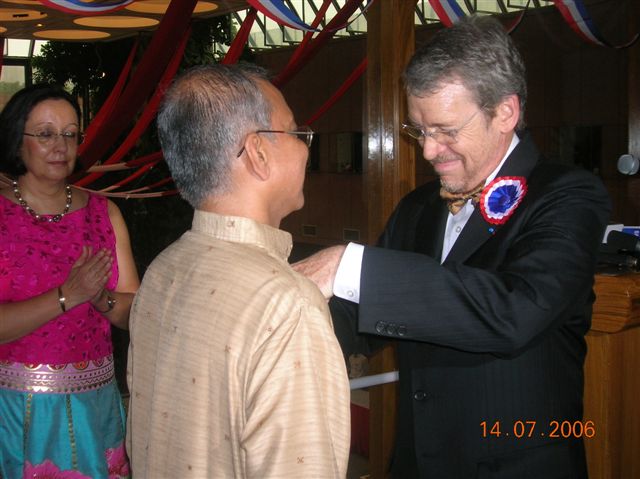
* {Fr. Cedric Prakash sj is the Director of PRASHANT, the Jesuit Centre of Human Rights, Justice and Peace in the State of Gujarat in North-west India. Fr. Prakash is also a member of the Citizens for Justice and Peace that set up the Concerned Citizens’ Tribunal to look into the Gujarat Carnage which took place in 2002; he has also testified before the US Commission on International Religious Freedom on the carnage. He is actively involved in issues related to communal harmony, justice and peace. He is the recipient of several awards and citations. On 14th July 2006, he was conferred the Chevalier de la Legion d’Honneur (Knight of the Legion of Honour) by the President of France, for his lifetime commitment to the promotion of human rights. . In June 2003, he was awarded the Rafi Ahmed Kidwai Award for Humanitarian Service by the Indian Muslim Council, USA. In 1995, he was awarded the Kabir Puraskar by the President of India for the promotion of communal peace and harmony